
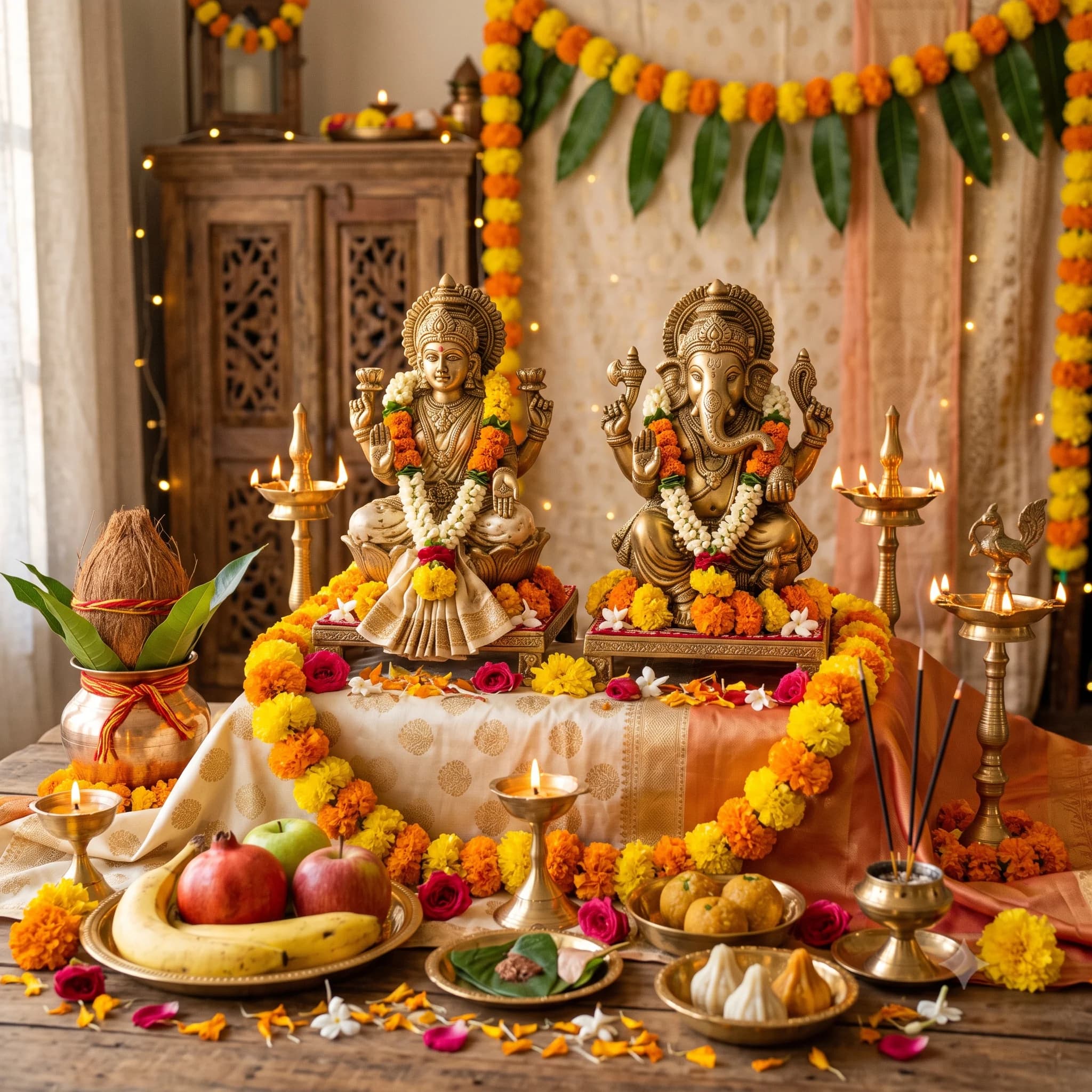
Diwali, or Deepavali, is the festival of lights. At its centre is the evening pooja to Goddess Lakshmi, the giver of prosperity, together with Lord Ganesha, the remover of obstacles. Families clean and light the home, offer prayers and share sweets.
Key takeaways
- Lakshmi pooja is performed in the evening, after sunset, on the new-moon (Amavasya) day of Diwali.
- Lord Ganesha is worshipped first, then Goddess Lakshmi.
- The exact muhurat depends on your city. Check a panchang or ask your pandit each year.
- Diwali is a five-day festival, and Lakshmi pooja is the main day.
Why Diwali is celebrated
Diwali is associated with several traditions. Many families celebrate the return of Lord Rama to Ayodhya after exile. Others remember Lord Krishna's victory over the demon Narakasura, and worship Goddess Lakshmi, who is said to visit clean, lit homes. The shared theme is the victory of light over darkness and of knowledge over ignorance.
The five days of Diwali
- Dhanteras: worship of Lakshmi and Dhanvantari, and a day when many families buy something auspicious.
- Naraka Chaturdashi: lamps and an early-morning bath, linked to the victory over Narakasura.
- Lakshmi Pooja: the main evening pooja on Amavasya.
- Govardhan Pooja / Annakut: remembered in many regions as the day Krishna lifted Mount Govardhan.
- Bhai Dooj: brothers and sisters honour one another.
How Lakshmi-Ganesh pooja is performed at home
- Prepare: clean the home, draw rangoli at the entrance and light diyas.
- Set the altar: place images or idols of Lakshmi and Ganesha on a clean cloth, with a kalash beside them.
- Sankalp: state your name, gotra and the intention of the pooja.
- Ganesh pooja: offer flowers, durva grass and sweets to Ganesha first.
- Lakshmi pooja: offer kumkum, flowers, sweets and coins, and recite a Lakshmi stotra or the Shri Suktam if your family does.
- Aarti: conclude with aarti and share the prasad.
- Light the home: place lamps at the entrance, windows and every room.
Businesses often also perform a pooja for their account books and tools on this day, known as Chopda Pujan in many regions.
Samagri for Diwali pooja
- Images or idols of Lakshmi and Ganesha
- Diyas, ghee or oil, and wicks
- Camphor and incense
- Marigold and lotus flowers
- Roli, turmeric, kumkum and rice
- Sweets, fruit and puffed rice for prasad
- Coins, and currency notes if your family places them
You can arrange these yourself or order a Lakshmi-Ganesh samagri kit before the festival.
Best time for Lakshmi pooja
The pooja is traditionally done in the evening, in the Pradosh period after sunset on Amavasya. The precise muhurat changes by city and by year, so confirm it from a local panchang or with your pandit instead of relying on a fixed clock time. The festival falls in October or November.
Frequently asked questions
Can Diwali pooja be done at home without a pandit?
Yes. Many families perform it themselves. A pandit adds the correct mantras, the sankalp and the exact muhurat, and is helpful for businesses and for families abroad. You can book a verified pandit for Lakshmi-Ganesh pooja.
Why is Ganesha worshipped before Lakshmi?
Ganesha is invoked at the start of nearly every ritual to remove obstacles. Lakshmi pooja follows once the way is clear.
What if I miss the muhurat?
Do not worry. The pooja can still be done with devotion within the evening. Ask your pandit if you want to confirm what is best for your family.
Planning your Lakshmi pooja?
Get the right muhurat and a pandit for your home or business.
