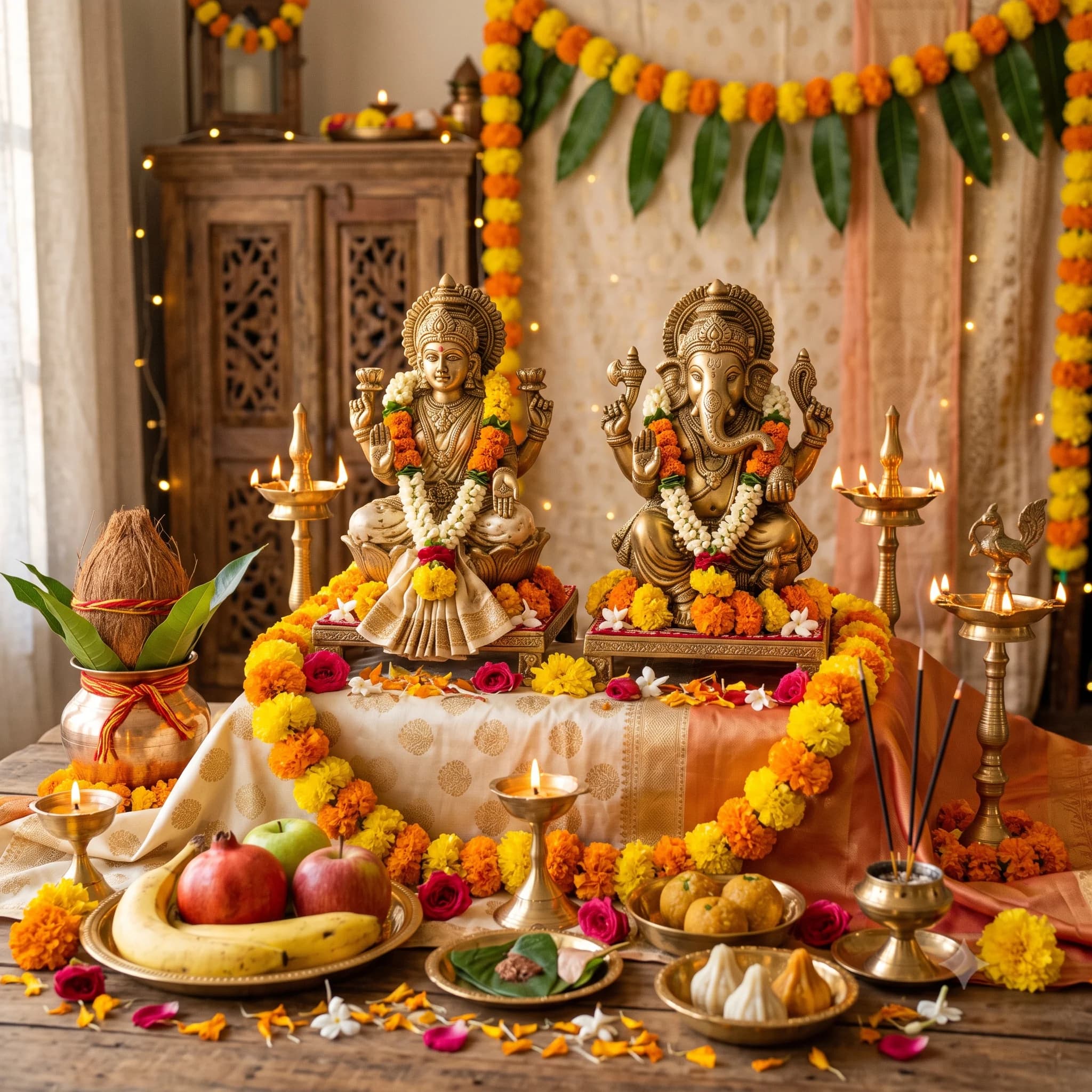

Dussehra, also called Vijayadashami, is the festival of the victory of good over evil. It falls on the tenth day of the bright fortnight of Ashwin, the day after the nine nights of Navratri. For some it is the day Rama defeated Ravana, for others the day Goddess Durga defeated Mahishasura. Both stories carry the same message: dharma prevails.
Key takeaways
- Dussehra (Vijayadashami) is celebrated on Ashwin Shukla Dashami, the tenth day after the start of Navratri.
- Two legends sit at its heart: Rama's victory over Ravana, and Durga's victory over Mahishasura.
- The day is also linked to the Shami tree and the Pandavas, and to the worship of weapons, tools and books.
- It is celebrated differently in each region, from Ramlila in the north to Durga Puja in Bengal and Dasara in Mysuru.
What the name means
Vijayadashami combines "vijaya" (victory) and "dashami" (the tenth lunar day). Dussehra comes from "dasha" (ten) and "hara" (to remove or defeat), a name often linked to the ten-headed Ravana. The tenth day marks the end of a long period of worship, and the start of new endeavours.
Legend 1: Rama and Ravana
In the Ramayana, Ravana, the king of Lanka, abducted Sita. After a great war, Rama defeated him on the tenth day. In north and central India the festival is celebrated with Ramlila, a dramatic retelling of Rama's life over several nights, and it ends with the burning of effigies of Ravana, his brother Kumbhakarna and his son Meghnada. The burning is a symbol of destroying arrogance, anger and ego within oneself.
Legend 2: Durga and Mahishasura
The Devi Mahatmya tells how the gods, unable to defeat the buffalo demon Mahishasura, combined their powers into Goddess Durga. After a battle of nine days she slew him, and the tenth day marks her victory. This is the heart of Durga Puja in Bengal, Odisha and Assam, and of Navratri across India. See our guide to Navratri and the nine forms of Durga.
The Shami tree and the Pandavas
A tradition tied to the Mahabharata says that the Pandavas, during their final year of exile in disguise, hid their weapons in a Shami tree. On Vijayadashami they took them back and went on to victory. For this reason the Shami tree is worshipped on the day in many regions, and in Maharashtra and Karnataka the leaves of the Apta or Shami tree are exchanged as "gold" with elders and friends.
Worship of tools and books
In South India, Ayudha Puja on Mahanavami and Vijayadashami honours instruments of work: tools, vehicles, machines, books and musical instruments. On Vijayadashami many families begin a child's education with Vidyarambham. People also see the day as favourable to start new ventures, and it is traditionally counted among the most auspicious days of the year.
How regions celebrate
- North and central India: Ramlila, and the burning of the effigies of Ravana at sunset. Delhi's Ramlila grounds and the Varanasi Ramlila are well known.
- West Bengal, Odisha, Assam: Durga Puja ends with the immersion of the idol and, in Bengal, Sindoor Khela and Bijoya greetings.
- Karnataka: the royal Mysuru Dasara, a ten-day celebration with a procession.
- Kullu, Himachal: the Kullu Dussehra begins on Vijayadashami and continues for a week, with processions of local deities.
- Tamil Nadu, Andhra Pradesh, Kerala: Golu displays, Saraswati and Ayudha Puja, and Vidyarambham.
- Gujarat and Maharashtra: the end of Garba, a visit to temples and the exchange of Apta leaves.
What it means for you
Dussehra invites a quiet question: what is my own "Ravana", the habit or anger or pride that I would like to let go of? Many families use the day to begin something new, honour the tools of their work, and spend time together. For the step-by-step worship, read our guide to the Vijayadashami puja vidhi.
Dussehra, Diwali and what follows
Dussehra comes about twenty days before Diwali. Preparations for the festival of lights usually begin soon after. See our guide to Diwali and, for families abroad, Diwali puja abroad.
Frequently asked questions
Why is Dussehra on the tenth day?
Because it follows nine days of worship (Navratri), and the tradition places the victories of Durga and Rama on the tenth.
Is Dussehra the same as Navratri?
No. Navratri is the nine nights, and Dussehra is the tenth day that concludes them.
Why are effigies burned?
They represent ten faults, such as pride and anger, that a person should overcome. The burning is a symbolic act.
Looking for personalised guidance?
Speak with an Āchārya, or plan a ceremony with a pandit.