Navagraha Shanti Puja is a powerful Vedic ritual that propitiates all nine planetary deities - Sun, Moon, Mars, Mercury, Jupiter, Venus, Saturn, Rahu, and Ketu - to harmonise their cosmic influences on your life and family.
Key takeaways
- Navagraha Shanti worships the nine planetary deities to ask for harmony in their influence.
- It is usually done for a specific reason: a difficult transit, before a wedding or Griha Pravesh, or on a jyotishi's advice.
- It is commonly performed at home by a pandit trained in Navagraha vidhi, and takes two to three hours.
- It is a shanti ritual of faith and intent. It does not guarantee outcomes.
The Nine Grahas and Their Domains
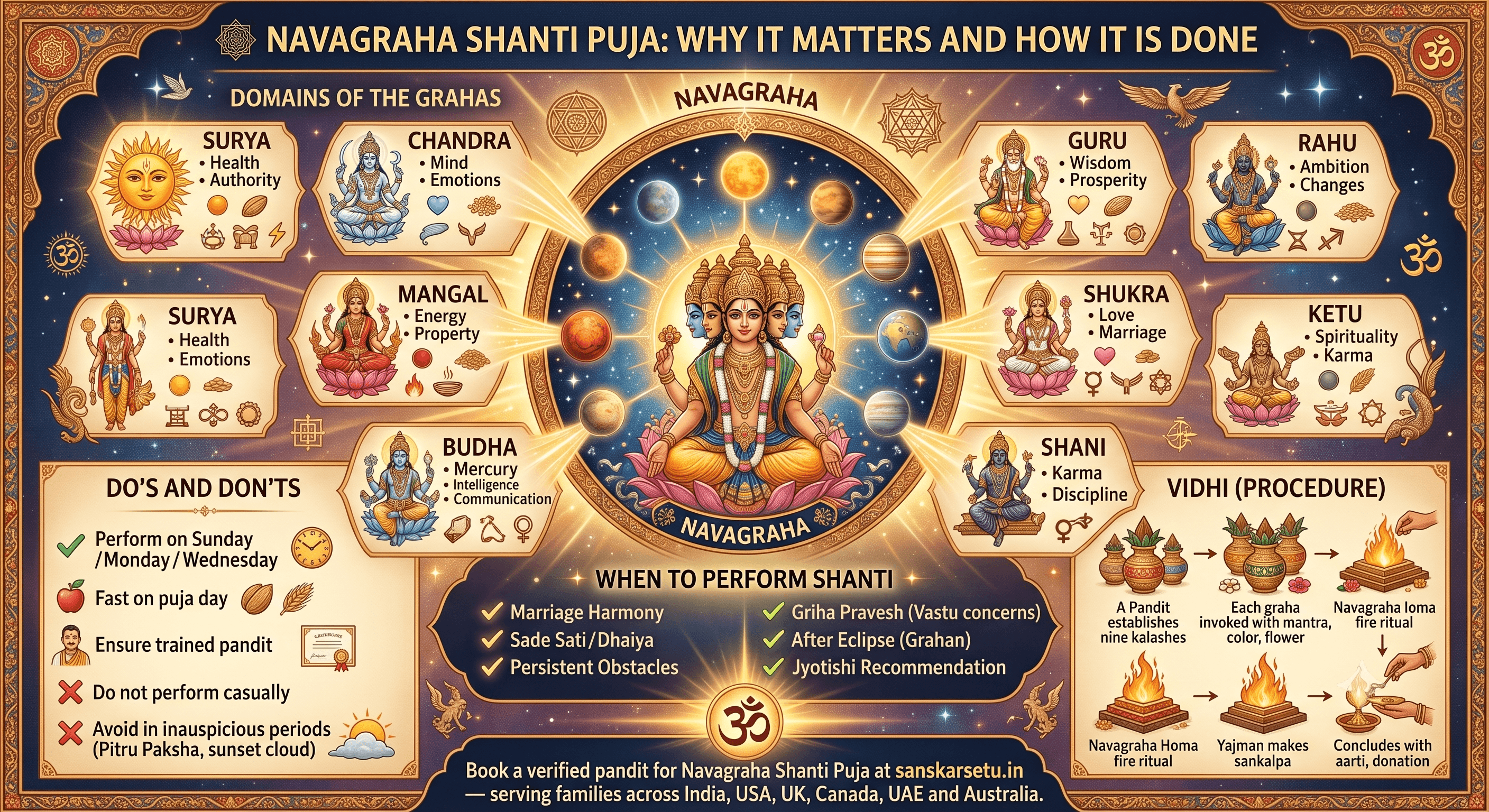
- Surya (Sun): Health, authority, father, career
- Chandra (Moon): Mind, emotions, mother, fertility
- Mangal (Mars): Energy, courage, brothers, property
- Budha (Mercury): Intelligence, communication, business
- Guru (Jupiter): Wisdom, children, dharma, prosperity
- Shukra (Venus): Love, beauty, marriage, luxury
- Shani (Saturn): Karma, discipline, longevity, service
- Rahu: Ambition, foreign connections, sudden changes
- Ketu: Spirituality, liberation, past karma
Benefits of Navagraha Shanti Puja
Families typically turn to this puja to ease a specific difficulty rather than as a routine ritual. The benefits most often sought include:
- Relief during Sade Sati or Dhaiya - softening Saturn's transit through the Moon sign
- Steadier career and finances - when Surya, Budha, or Guru are weak or afflicted in the birth chart
- Better health and vitality - Navagraha doshas are frequently linked to recurring health concerns
- Smoother relationships and marriage prospects - particularly when Mangal Dosha or a weak Shukra is involved
- Clearer decision-making - many describe reduced mental restlessness once the homa is complete
- Auspicious groundwork - before a wedding, Griha Pravesh, or a major life decision, to start with planetary support rather than resistance
It is a shanti (pacifying) ritual, not a guarantee - a qualified jyotishi will usually confirm from your kundali which grahas need attention before the puja is arranged, so the remedy matches the actual affliction.
When Should You Perform Navagraha Shanti?
- Before a marriage - to ensure planetary harmony for the couple
- During Sade Sati or Dhaiya (Saturn transit period)
- When facing persistent obstacles in career, health, or relationships
- Before Griha Pravesh - especially if the property has vastu concerns
- After an eclipse (Grahan) - particularly if the eclipse affects your natal Moon or Ascendant
- When a jyotishi recommends it based on your Dasha or transit analysis
Can Navagraha Shanti Puja Be Done at Home?
Yes - Navagraha Shanti is regularly performed at home, and for most families that is the norm rather than the exception. What changes is the scale, not the validity of the ritual:
- A pandit trained in Navagraha vidhi can set up the nine kalashes and conduct the full homa in your puja room, courtyard, or a covered terrace - a temple visit is not required
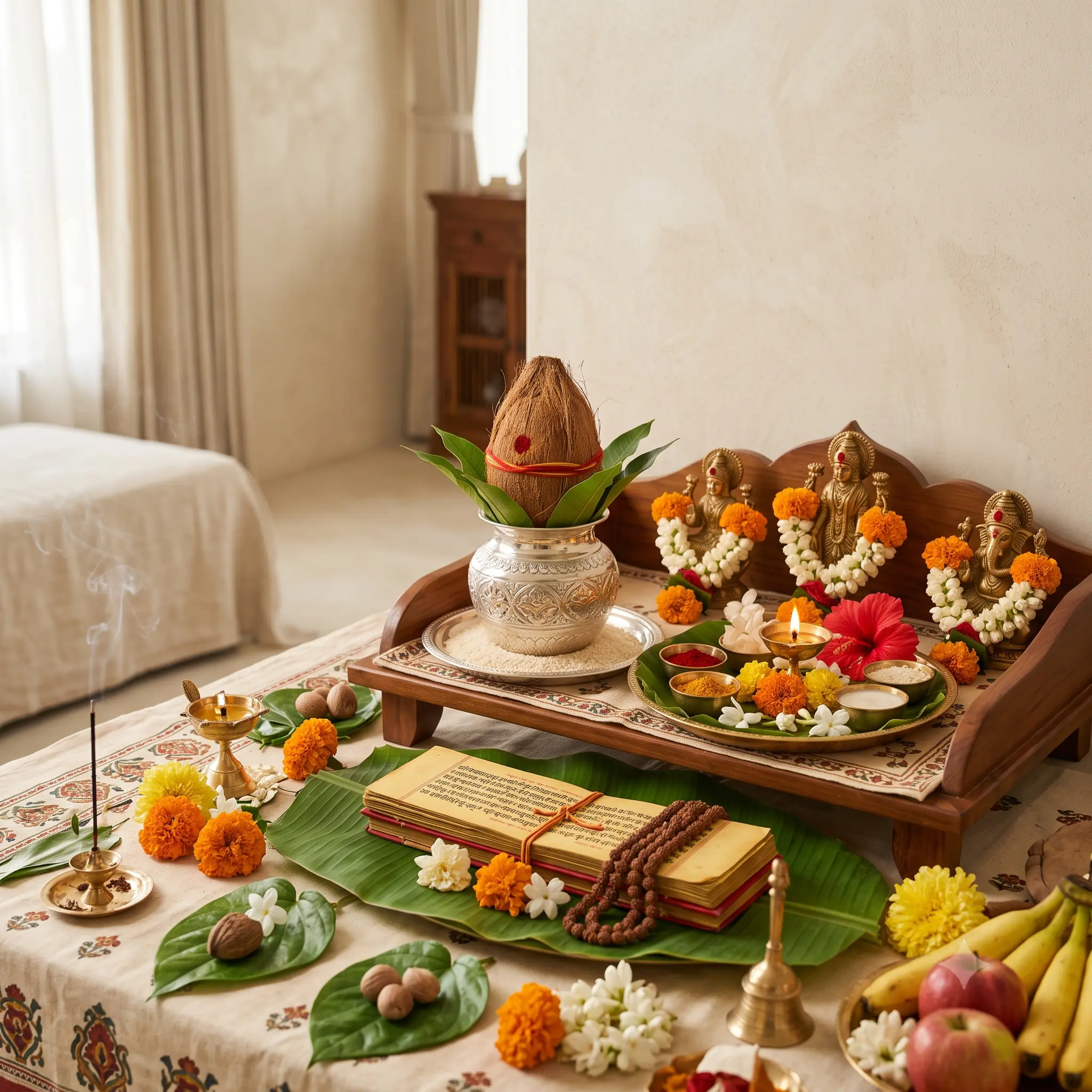
- You will need a clean, ventilated space for the havan kund (fire ritual), the nine-kalash arrangement, and seating for the yajman (the person on whose behalf the puja is done)
- The pandit brings or advises on the samagri - nine grains, nine colours of cloth, specific flowers, and offerings for each graha
- A simplified home version (shorter mantra recitation, fewer offerings) is possible if time or space is limited, but the sankalpa and core mantras for each graha should not be skipped
The one thing that does not change with location is the need for a qualified purohit - this is a technically demanding puja, and an inexperienced reading of the mantras is considered ineffective by tradition.
The Vidhi (Procedure)
- A qualified pandit establishes nine kalashes representing the nine grahas
- Each graha is invoked with its specific mantra, colour, flower, grain, and offering
- Navagraha homa (fire ritual) is performed with individual mantras for each planet
- The yajman (person performing the puja) makes sankalpa stating the purpose
- Concludes with aarti, prasad distribution, and donation to the priest
Do's and Don'ts
- Perform on a Sunday (Sun), Monday (Moon), or Wednesday (Mercury) for general shanti
- Fast on the day of the puja or eat only once
- Ensure the pandit is trained in Navagraha vidhi - it is a complex puja
- Do not perform this puja casually - it requires proper sankalpa and a qualified purohit
- Avoid during inauspicious periods like Pitru Paksha for new initiations
Frequently Asked Questions
When should you do Navagraha Pooja?
Most families schedule it before a marriage or Griha Pravesh, during a Sade Sati or Dhaiya transit, after an eclipse that touches their natal Moon or Ascendant, or whenever a jyotishi identifies a weak or afflicted graha during a kundali consultation. There is no single fixed date - it is timed to your chart and your current transits, ideally on a Sunday, Monday, or Wednesday.
Can Navagraha Shanti Puja be done at home?
Yes. It is commonly performed at home with a pandit who brings the setup for the nine kalashes and homa. You only need a clean, ventilated space - a puja room, courtyard, or terrace works. What matters more than the location is that the pandit is properly trained in Navagraha vidhi, since the mantras and sankalpa are specific to each graha.
What are the benefits of Navagraha Shanti Puja?
It is used to ease Sade Sati or Dhaiya, support career and financial stability, address recurring health concerns linked to a weak graha, smooth out marriage or relationship difficulties tied to Mangal Dosha, and create an auspicious start before a wedding or house-warming. It works best as a targeted remedy for a specific affliction identified in your kundali, not as a general-purpose ritual.
How long does Navagraha Shanti Puja take?
A full Navagraha homa with all nine invocations typically takes two to three hours, depending on the pandit's pace and whether additional remedies (like a Rudrabhishek or specific graha shanti) are combined with it.
Who should perform Navagraha Shanti Puja?
Anyone can be the yajman - the puja is done on your behalf by a purohit trained specifically in Navagraha vidhi. Because each of the nine planets has its own mantra, colour, grain, and offering, this is not a puja to attempt without a qualified priest.
Looking for Navagraha Shanti?
A pandit can perform it with the right vidhi for your kundali.