
Navratri puja at home is simple in its structure: install the kalash on the first morning, worship the goddess morning and evening for nine days, and close the festival with Kanya Puja and a prayer of gratitude. This guide gives the full vidhi in plain steps, with the mantras, the way to perform aarti, and notes for families living abroad. Families differ in detail, so follow your own kul parampara where it is more specific.
Key takeaways
- The nine days begin with Ghatasthapana (kalash sthapana). Barley is sown beside the kalash and watered daily.
- The daily puja is short: lamp, incense, flowers, bhog, a mantra or path, and aarti, in the morning and again in the evening.
- An akhand jyot (lamp kept burning all nine days), full fasting and the Durga Saptashati are all optional and depend on family tradition and health.
- You can do the whole puja yourself. A pandit helps with the sankalp, a havan or a Saptashati path.
Samagri for Navratri puja
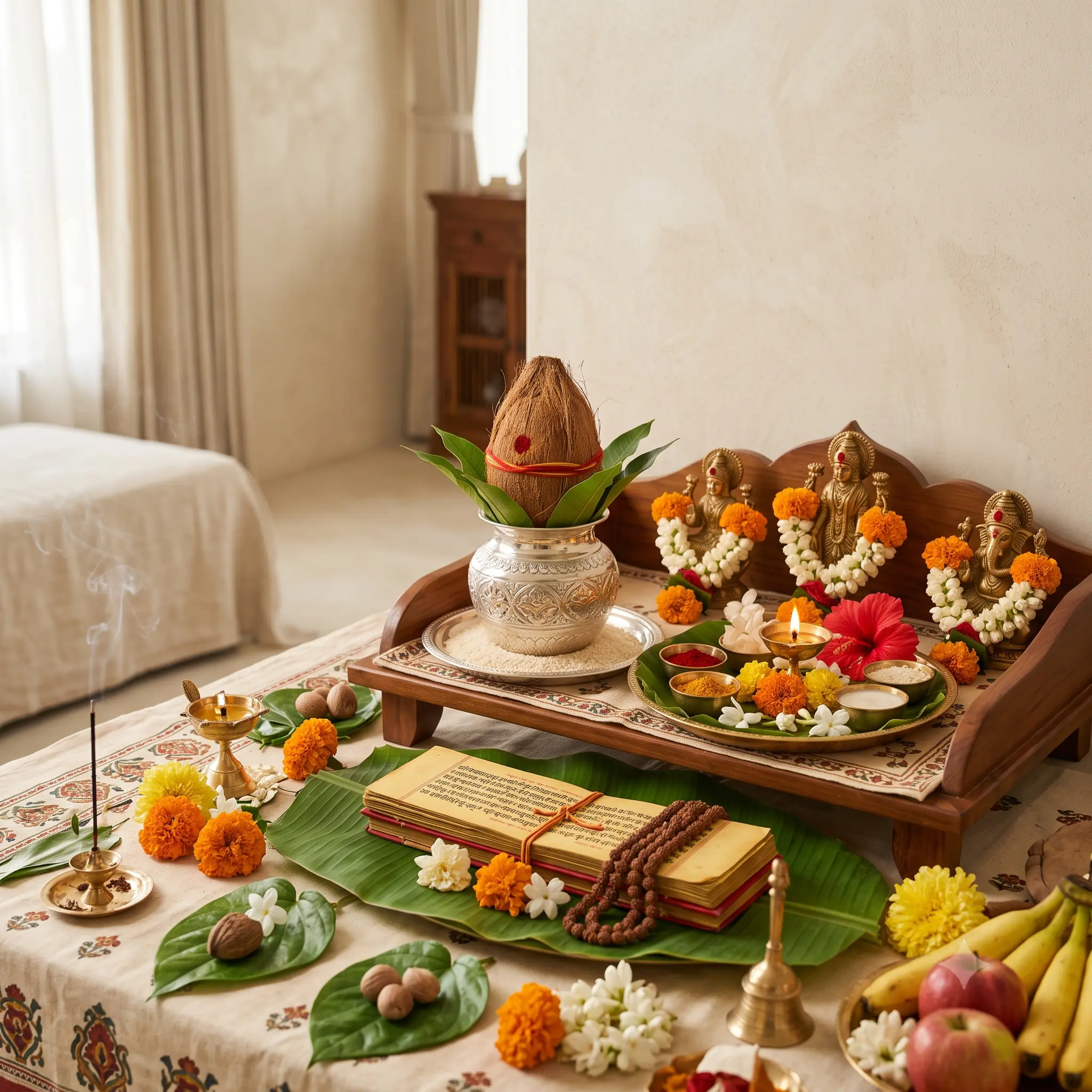
- A kalash of copper, brass or clay, and a wide earthen pot or tray for the barley
- Clean soil and barley (jau) seeds
- Clean water, with a little Ganga jal if you have it
- Five or seven mango leaves, and a coconut with its husk
- Red cloth, moli (kalawa), roli or kumkum, akshat (unbroken rice), supari and a coin
- Flowers (red hibiscus is traditionally offered to the goddess), and a garland
- A picture, idol or yantra of Durga, and a clean seat or chowki with a cloth
- A ghee diya, incense, camphor, fruit and sweets for bhog
Our Durga Saptashati samagri kit and Kanya Puja kit cover many of these items. Families abroad will find substitutes in our samagri guide for the USA, UK and Canada.
Before you begin
- Clean the home and the puja space the day before. The north-east corner is commonly chosen, and you sit facing east or north.
- Bathe and wear clean clothes on the first morning.
- Confirm the muhurat for your city. See Navratri 2026 dates and Ghatasthapana muhurat.
Step-by-step Ghatasthapana (kalash sthapana)
- Sankalp. Sit at the puja space with water, rice and a flower in your right hand. State your name, the place, the date, and your intention for the nine days, for example the well-being of the family. If you do not know the Sanskrit sankalp, say it in your own words with sincerity.
- Invoke Ganesh. Begin with a short prayer to Ganesh to remove obstacles. Light the lamp and incense.
- Prepare the barley bed. Spread a layer of clean soil in the wide pot, sow the barley seeds, and sprinkle a little water.
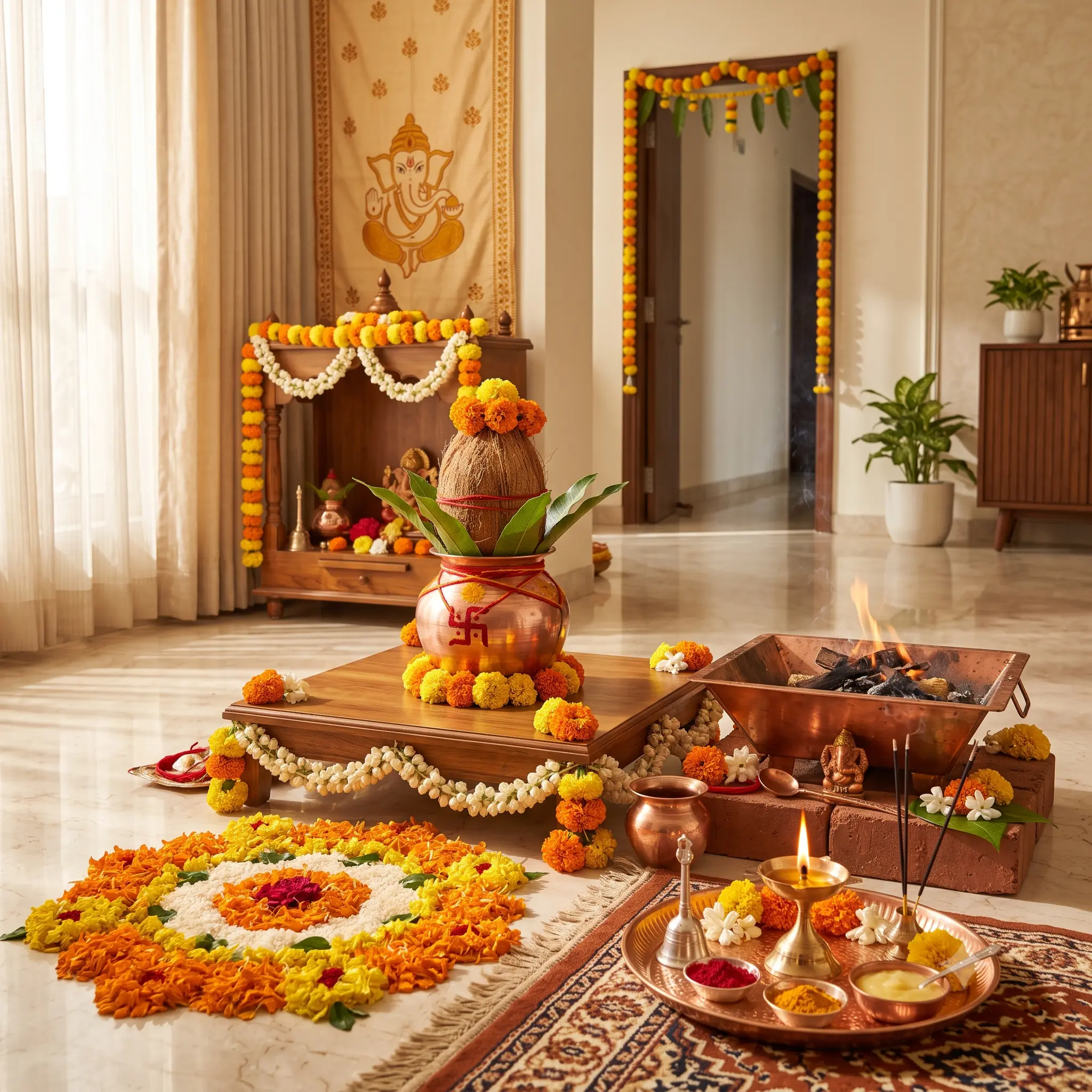
- Prepare the kalash. Fill the kalash with clean water, adding a little Ganga jal, a supari, a coin and a few grains of rice. Tie moli around its neck and apply roli.
- Place the leaves and coconut. Arrange the mango leaves around the mouth of the kalash. Wrap the coconut in red cloth, tie it with moli, and place it on top.
- Install the kalash. Set the kalash steadily on or beside the barley bed. Invite Goddess Durga and the deities into the kalash with folded hands.
- Worship. Offer roli, akshat, flowers and the garland, then light the lamp, offer incense, bhog and finish with aarti.
Place the idol or picture of Durga beside the kalash. Many families also light an akhand jyot. This is a personal choice and needs care, so it should never be left unattended, and in apartments abroad please read our fire safety guide first.
The daily puja for nine days
The daily puja can be kept short and regular. Morning and evening, do the following:
- Wash hands, sit at the puja space, and light the lamp and incense.
- Offer fresh flowers and a little water to the kalash and the goddess.
- Offer bhog, a fruit or sweet, with a prayer.
- Chant a mantra, read from the Durga Chalisa or the Durga Saptashati, or simply sit in prayer.
- Perform aarti and offer the prasad to the family.
Sprinkle a little water on the barley once a day and keep it out of direct harsh sun. The green shoots that grow over the nine days are called jawara and are kept as prasad. On each day, you may remember the form of Durga worshipped that day, from Shailputri to Siddhidatri. Our guide to the nine forms of Durga lists them.
Mantras to chant
Mantras are chanted as a quiet daily practice. You can chant them as many times as you are comfortable with. Counting with a mala, for example 108 times, is a common choice.
- Navarna mantra: Om Aim Hreem Kleem Chamundayai Vichche. A traditional mantra of Durga, widely chanted during Navratri.
- Devi stuti verse from the Devi Mahatmya: Sarva-mangala-mangalye shive sarvartha-sadhike, sharanye tryambake gauri narayani namostute. It means: salutations to the auspicious one, the giver of all good, the refuge, the three-eyed Gauri, Narayani.
- Durga Saptashati (Devi Mahatmya): the scripture of 700 verses in 13 chapters. Many families read it across the nine days, and others hold a path with a pandit. See our Durga Saptashati path.
Pronunciation matters, so if you are unsure of a mantra, listen to a trusted teacher or ask a pandit before you begin, and chant slowly.
How to perform aarti
Aarti is the closing act of every puja, a way of offering light to the deity with love. Many people search for the aarti text during Navratri. The most widely sung aarti of the goddess in homes and mandirs is "Jai Ambe Gauri", and the Durga Chalisa is also popular. We do not print the aarti text here. Use your family's aarti book or the version your temple sings, because the verses differ from region to region. What matters is the way you offer it:
- Light a ghee diya, or a piece of camphor on a plate. Keep a bell nearby.
- Stand in front of the goddess, ring the bell gently, and begin to sing the aarti with the family.
- Move the plate in a slow, clockwise circle before the deity. A common practice is four circles at the feet, two at the navel, one at the face, and seven over the whole form.
- When the aarti ends, offer a little water around the plate, and let everyone take the warmth of the flame with the palms and touch it to the eyes and head.
- Distribute the prasad.
Fasting during Navratri
Fasting is a personal choice, and the rules vary by region and family. Many people avoid grains, onion, garlic and non-vegetarian food for the nine days, and eat fruit, milk, sabudana, kuttu and sendha namak foods. Some fast on all nine days, some only on the first and last, and some do not fast at all but eat simple sattvic food. If you are unwell, elderly, pregnant or on medication, do not fast against medical advice. Devotion matters more than strictness.
Ashtami, Navami and Kanya Puja
On Ashtami or Navami, many families invite nine young girls, and sometimes a young boy, wash their feet, apply tilak, offer a meal of puri, chana and halwa, and give small gifts. This is Kanya Puja. Read more on our Kanya Puja page. Some families also perform a small havan on Navami.
Closing the nine days
On Navami or Dashami, offer a final puja and aarti, and thank the goddess for the nine days. The kalash is then concluded with a prayer. The water of the kalash is sprinkled around the home and the jawara is kept as prasad, or placed respectfully in a plant or flowing water, according to your family custom. Vijayadashami follows on the tenth day. See Vijayadashami puja vidhi.
Common mistakes to avoid
- Collecting the samagri on the morning itself. Prepare the day before.
- Setting an unsteady kalash. Place it on a firm base so it does not tilt.
- Leaving a lamp unattended, especially an akhand jyot.
- Treating strict fasting as the measure of devotion, or fasting against health advice.
- Chanting a mantra you cannot pronounce. Learn it first.
For families abroad
Check the muhurat for your own city and time zone. Use substitutes for items you cannot find, follow the fire safety rules of your building, and consider an electric or small lamp where an open flame is not allowed. If you would like a pandit to guide the sankalp or lead a path by video, read how an online puja works or see pandit services for NRIs.
Frequently asked questions
Is akhand jyot compulsory in Navratri?
No. It is a family tradition, not a requirement. A lamp lit during the morning and evening puja is enough for most households.
Can I do Navratri puja at home without a pandit?
Yes. A simple puja done with faith is valid. Ask a pandit for help with the sankalp, a havan or the Saptashati path.
Do I need to fast on all nine days?
No. Fasting is a personal choice and varies by tradition. Do what suits your health and family custom.
What if I miss the Ghatasthapana muhurat?
Many pandits advise the Abhijit muhurat as the alternative. It is not traditionally done at night. Ask your pandit what is best for your situation.
Which aarti is sung during Navratri?
"Jai Ambe Gauri" is the aarti most families sing, and many also sing the Durga Chalisa. Use the version of your family or temple.
Looking for personalised guidance?
Speak with an Āchārya, or plan a ceremony with a pandit.