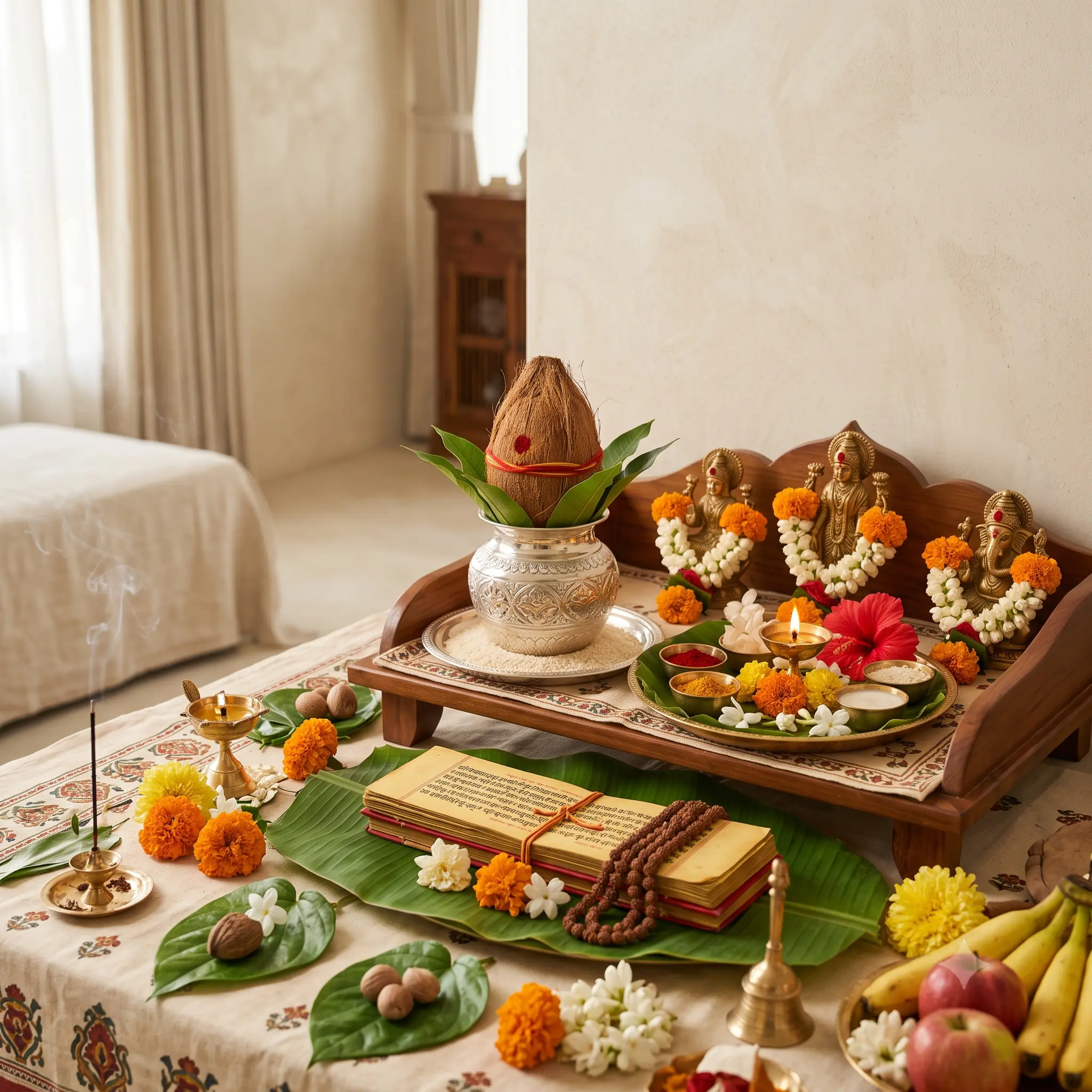
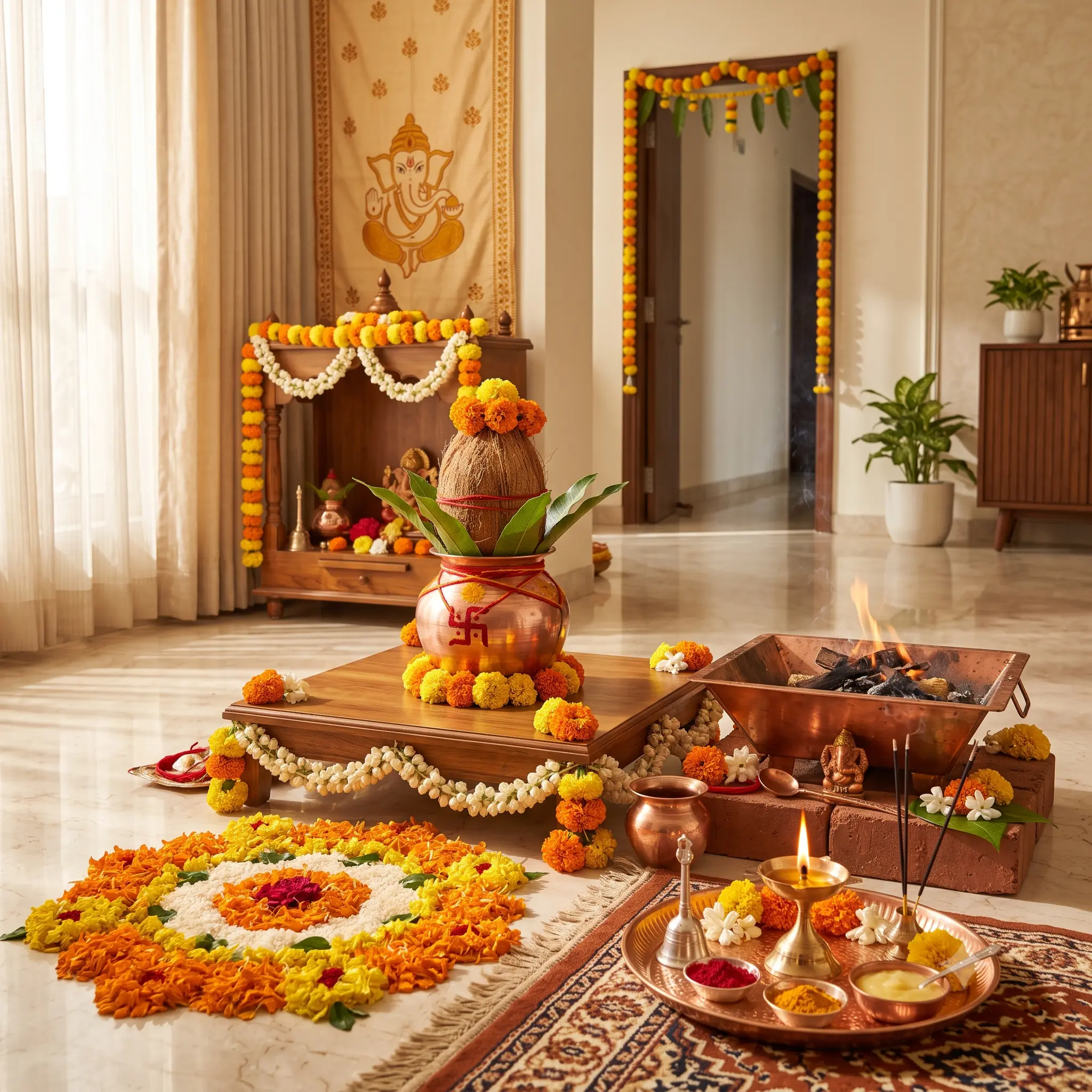
Buying or renting a home abroad is a big step, and most families want to begin it with a Griha Pravesh. The ceremony is the same wherever you live, but a few practical questions are different outside India: which date and time to use, what to do in an apartment, how to arrange samagri and whether a havan is allowed. This guide answers them.
Key takeaways
- Use a panchang prepared for your own city. Tithi, nakshatra and sunrise change with location, so an India date can be wrong for Houston or London.
- Griha Pravesh can be done in an apartment, a condo or a rented home. What matters is that the family is entering the home for the first time to live there.
- A havan needs fire safety planning in a flat. A ghee lamp and a simpler ceremony are valid alternatives.
- A pandit can conduct the ceremony in person, or guide you by video while you perform it at home.
Is Griha Pravesh needed for an apartment or rented home
Yes, many families do it. Tradition places importance on the first entry and on blessing the space where the family will live, whether the family owns or rents it. Some families keep it shorter for a rented home, with a Ganesh pooja, a kalash and a small prayer. Ask your pandit what suits your tradition.
Choosing the date and time abroad
The Hindu day is counted from local sunrise. That means tithis and nakshatras are timed differently in New Jersey, Toronto and London than they are in Delhi. Always use a panchang calculated for your own city or a nearby one, and write the muhurat in your local time, including daylight saving time. Our guides to reading a panchang and to muhurat for NRIs explain this in detail.
Many traditions prefer to complete the entry within a muhurat, and some avoid Chaturmas, Pitru Paksha and Adhik Maas. Because most people abroad work on weekdays, families often choose the closest suitable weekend, with the entry itself timed within the muhurat. Confirm the exact time with your pandit.
Preparing the home
- Move in the basic items first: a kitchen vessel for boiling milk, rice, sugar and the pooja space items.
- Clean the home and keep the entrance clear. A toran of mango leaves can be replaced with fresh flowers if mango leaves are not available.
- Check that utilities (electricity, water, gas, internet) are connected, as the first day should feel lived in.
- Choose a clean, quiet corner for the pooja space, ideally facing east or north.
- Tell neighbours if you expect many guests, singing or a havan.
Samagri outside India
Most items are available at Indian grocery stores in larger cities, or online. A few, such as bel leaves, durva grass or fresh mango leaves, can be hard to find, and fresh plant material is often restricted when shipped across borders. See our guide to puja samagri in the USA, UK and Canada for substitutes. You can also check the contents of our Griha Pravesh samagri kit and use it as a checklist.
Havan in an apartment
A havan produces smoke and an open flame. In a flat or a rented home, check your lease and building rules, and make sure smoke alarms will not trigger. Use a small havan kund, dry samidha and a ventilated space, and keep water nearby. If a full havan is not possible, a ghee lamp, camphor aarti and mantra chanting still carry the heart of the ceremony. Read more in our guide to havan in an apartment abroad.
The ceremony in outline
- Ganesh pooja and sankalp with the family's names and gotra.
- Kalash sthapana and Navagraha pooja.
- Vastu Purusha pooja and, if possible, a small havan.
- First entry, led by the lady of the house with a kalash, and boiling milk in the kitchen until it overflows.
- Aarti, prasad and often a Satyanarayan Katha.
For the full vidhi, read our Griha Pravesh guide.
Finding a pandit abroad
You have three options: a local pandit from your community or temple, a pandit who travels, or a pandit in India who guides the ceremony by video while you perform it. Read our checklist on how to choose a pandit abroad. You can also explore pandit support for NRI families or our Griha Pravesh page.
Frequently asked questions
Can we do Griha Pravesh after we have already moved in?
Tradition prefers it before the family begins living there. If you have already moved, ask your pandit. Many families still perform the ceremony to bless the home.
Do all family members need to be present?
The family living in the home should be there, and others may join by video. Elders can bless the ceremony remotely.
Is it all right to hold it on a weekend?
Yes, as long as the entry happens within a good muhurat. Your pandit can find the best window on that weekend.
Planning your Griha Pravesh?
We set the muhurat, match a pandit and can bring the full samagri.