
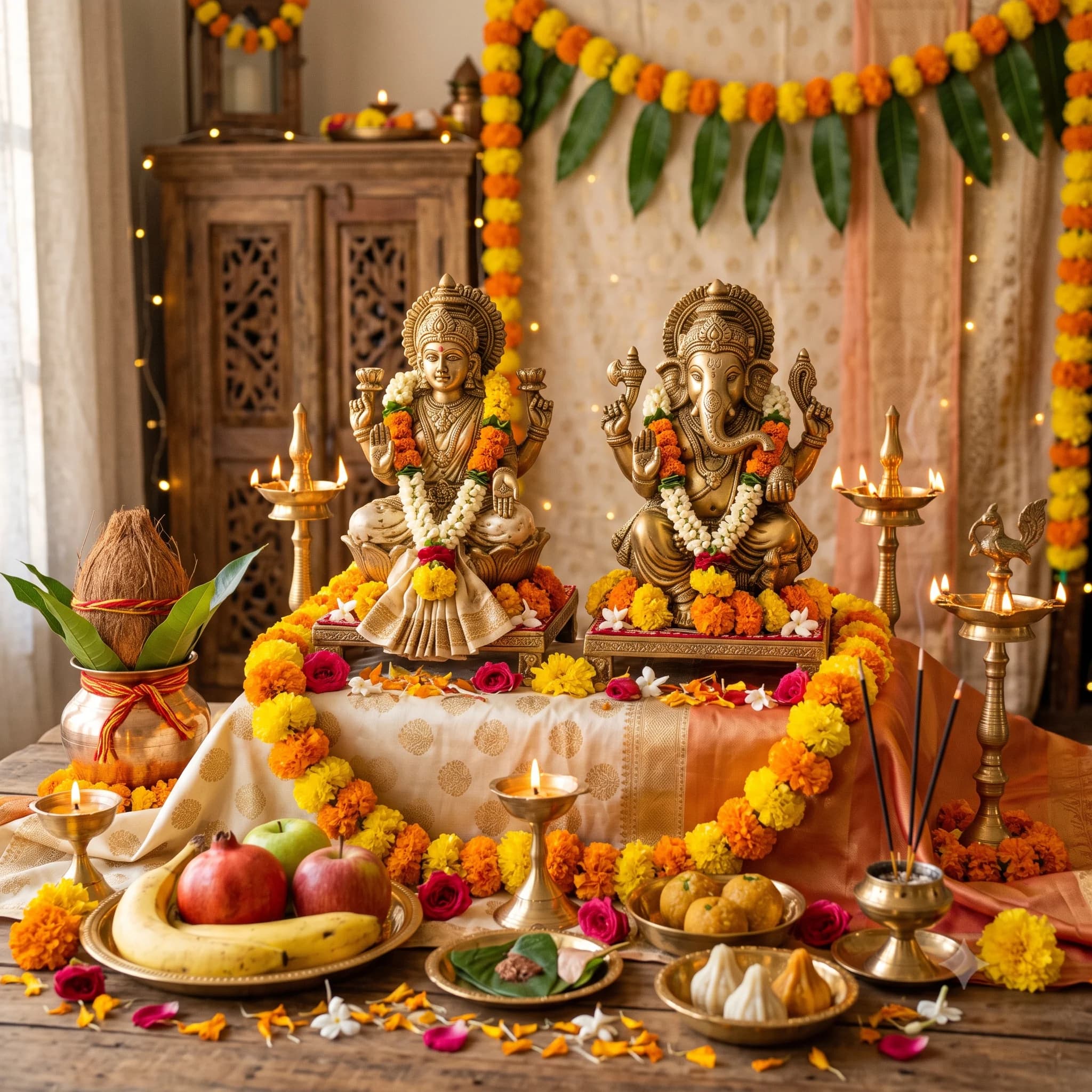
Diwali is the festival most missed by families far from home, and the one they work hardest to recreate. The good news is that Lakshmi-Ganesh puja can be done beautifully in a home anywhere. Here is how to plan it, in a way that respects both tradition and the realities of life abroad.
Key takeaways
- The date and the muhurat for Lakshmi Pujan depend on where you live. Use a panchang for your own city, and write the time in local time.
- The main puja is done in the evening of the Amavasya, in Pradosh Kaal. Many families abroad plan around work and school.
- A small, sincere puja with Lakshmi and Ganesha, a lamp and prasad is complete.
- Be careful with open flames, especially indoors. Use diyas with safe holders and keep water nearby.
The five days
Diwali is a festival of five days: Dhanteras, Naraka Chaturdashi (Choti Diwali), the main Diwali on Amavasya with Lakshmi Pujan, Govardhan Puja or Annakut, and Bhai Dooj. Regional traditions vary. Read our complete guide to Diwali pooja for the full picture.
Finding the muhurat for your city
Lakshmi Pujan is done in the evening, usually within Pradosh Kaal (the period after sunset) while the Amavasya tithi prevails. Since sunset and tithi timings are local, the date and the window can differ between India and your city. Use a panchang calculated for your location and time zone. If the tithi and the muhurat fall close to two days, or the dates differ from India, ask your pandit or temple which they follow. Our guide on muhurat for NRIs explains why. For the nature of Amavasya, see Amavasya.
Planning around a weekday
- Prepare the space, samagri and prasad the day before, so that the evening is calm.
- If the muhurat is early in the evening, plan the day around it, with a lighter schedule at work if possible.
- If you cannot do it within the main muhurat, ask your pandit about the best nearby time. Do the puja with sincerity.
- Involve children with simple tasks such as arranging flowers or lighting a diya with help.
Samagri
- Images or idols of Lakshmi and Ganesha, and a small kalash
- Diyas, ghee or oil, cotton wicks and matches
- Roli, akshat, turmeric, sandalwood, flowers and a red cloth
- Coins, rice, fruits, sweets and batasha
- Incense, camphor, a bell and a thali
A ready checklist is available in our Lakshmi-Ganesh puja kit. For items that are hard to find, see our samagri guide for families abroad.
A simple puja at home
- Clean the home and decorate the entrance with a rangoli and lights.
- Set up the chowki with a red cloth, Lakshmi and Ganesha, and the kalash.
- Take the sankalp. Light the lamp and worship Ganesha first.
- Worship Lakshmi with flowers, rice, coins and sweets. Chant a mantra such as "Om Shreem Mahalakshmyai Namah".
- Perform aarti and share prasad.
- Light diyas at the doorway and in the home, safely.
Fire safety with diyas
- Use a stable holder and keep diyas away from curtains, paper and decorations.
- Do not leave them unattended. Keep water or a fire extinguisher nearby.
- In an apartment, consider electric diyas for the outer decoration and a single ghee lamp for the puja. See havan in an apartment abroad.
Celebrating with family and community
- Join the community puja at your local temple or cultural centre, and bring your own diya.
- Video-call family in India during the aarti.
- Share sweets with neighbours. It is a lovely way to introduce the festival.
For personal support with the puja, you can look at our Lakshmi-Ganesh pooja page or NRI family support.
Frequently asked questions
Which date should we follow, India's or ours?
Most families follow the date for their own city. Some temples follow a specific tradition. Ask your temple or pandit.
Can we do Lakshmi puja after the muhurat if we work late?
Ask your pandit for the nearest suitable time. A sincere puja at a slightly later hour is accepted by many families.
Can we do it without a pandit?
Yes. A short vidhi and a simple puja are common at home. A pandit helps with the muhurat and the mantras.
Planning your Lakshmi pooja?
Get the right muhurat and a pandit for your home or business.
