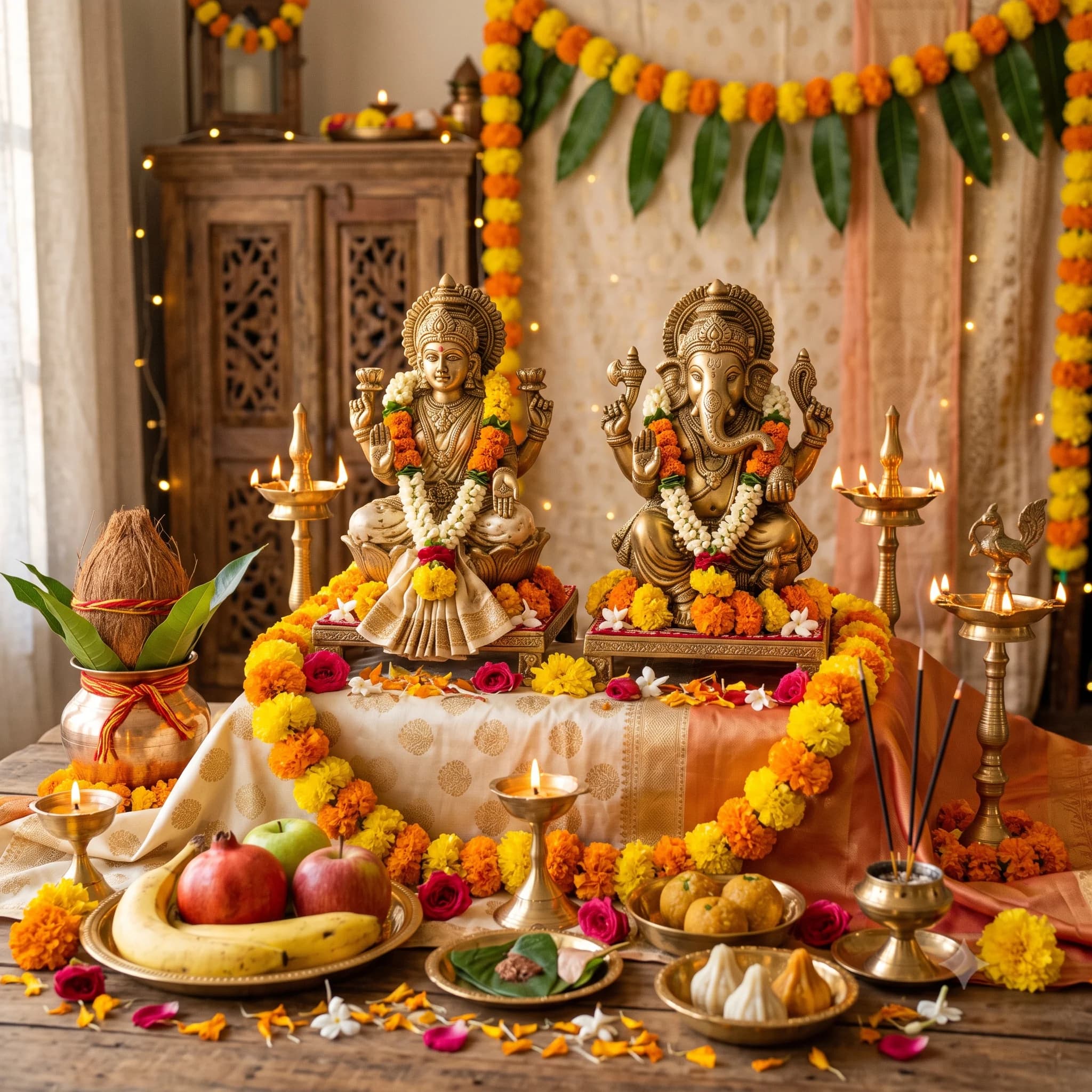

Sharad (Shardiya) Navratri 2026 begins on Sunday, 11 October, with Ghatasthapana, the installation of the kalash, on the morning of the first day. The nine nights run to 19 October, and Vijayadashami (Dussehra) follows on Tuesday, 20 October. This page gives the dates, the muhurat window, the goddess of each day, and how to check the exact time for your own city.
Key takeaways
- Navratri begins on Ashwin Shukla Pratipada, which falls on Sunday, 11 October 2026. Ghatasthapana (kalash sthapana) is done that morning.
- For New Delhi, panchang listings give the main Ghatasthapana window as about 6:19 AM to 10:12 AM, and the Abhijit muhurat as about 11:44 AM to 12:31 PM. Other cities differ by several minutes, so check your own city.
- Some panchangs note that Chitra nakshatra and Vaidhriti yoga fall in the morning window. In that case the usual advice is to use the Abhijit muhurat. Your family pandit can confirm which applies to you.
- Vijayadashami is on Tuesday, 20 October 2026. Ashtami and Navami fall at the end of the nine days, and their exact day can differ slightly by city.
Navratri 2026 at a glance
- Navratri begins: Sunday, 11 October 2026 (Ashwin Shukla Pratipada)
- Navratri ends: Monday, 19 October 2026 (Navami)
- Vijayadashami (Dussehra): Tuesday, 20 October 2026
- Festival: Sharad Navratri, the autumn Navratri, one of the two major Navratris of the year. The other is Chaitra Navratri in spring.
Dates here follow the commonly published panchang listings for India. A tithi can begin or end at a different hour in a different time zone, so a family in the USA, UK or Australia should check a panchang for their own city. Our guide to muhurat for families abroad explains how.
Ghatasthapana muhurat 2026
Ghatasthapana, also called kalash sthapana, is the first and most important act of Navratri. A kalash is installed to invoke the goddess, and barley is sown beside it. It is traditionally done in the morning, while Pratipada is in effect.
- Main window (New Delhi): about 6:19 AM to 10:12 AM on 11 October. Published times for other cities vary, for example about 6:27 AM to 10:23 AM for Pune.
- Abhijit muhurat (New Delhi): about 11:44 AM to 12:31 PM, used as the alternative.
- Pratipada tithi: begins on the evening of 10 October and ends on the evening of 11 October.
Some panchang sources point out that Chitra nakshatra and Vaidhriti yoga are in effect during the morning window, and these are traditionally avoided for Ghatasthapana. Where that applies, the advice given is to do it in the first part of the day while Pratipada prevails if that is possible, and otherwise in the Abhijit muhurat. Traditions and panchang schools do not always agree on this, so treat the times above as a guide and confirm with your pandit.
Ghatasthapana is not traditionally done at night. If a family cannot sit at the muhurat, a simple sankalp and kalash at the nearest suitable time, guided by a pandit, is better than skipping it. Our step-by-step Navratri puja vidhi walks through the whole procedure.
The nine days of Navratri 2026
Each day is dedicated to one form of Durga, the Navadurga. The listing below follows the usual nine-day count from Pratipada.
- Day 1, Sunday 11 October: Shailputri. Ghatasthapana and the start of the festival.
- Day 2, Monday 12 October: Brahmacharini
- Day 3, Tuesday 13 October: Chandraghanta
- Day 4, Wednesday 14 October: Kushmanda
- Day 5, Thursday 15 October: Skandamata
- Day 6, Friday 16 October: Katyayani
- Day 7, Saturday 17 October: Kalaratri
- Day 8, Sunday 18 October: Mahagauri. Durga Ashtami, often observed with Kanya Puja.
- Day 9, Monday 19 October: Siddhidatri. Maha Navami, also a day for Kanya Puja and havan.
The panchang can merge or repeat a tithi, which is why some years and some cities see Ashtami and Navami fall a day apart from the common listing. If you plan Kanya Puja, havan or a Durga Saptashati recitation on a particular day, confirm that day with your pandit. For the meaning of each form, read Navratri explained: the nine forms of Durga.
Ashtami, Navami and Vijayadashami
Many families keep their main observance on Ashtami or Navami. Kanya Puja, the worship of young girls as forms of the goddess, is done on one of these days according to family custom. See our page on Kanya Puja and the matching samagri kit.
Vijayadashami on 20 October closes the festival. It is the day of Aparajita and Shami puja, and of Ravana dahan in many places. Read Vijayadashami puja vidhi and the legends behind Dussehra.
What to prepare before the first morning
- Confirm your city muhurat from a trusted panchang or your pandit, and decide who will sit for the puja.
- Gather the kalash items: a clean kalash, clean soil, barley seeds, a wide pot or tray, mango leaves, a coconut, red cloth, moli, roli, rice, supari, a coin, flowers, a diya, ghee, incense and camphor.
- Clean the puja space the evening before and place the picture or idol of Durga.
- Plan the days: your fasting approach, the Ashtami or Navami observance, and whether you will read the Durga Saptashati.
Families living abroad can read our guides to puja samagri and substitutes in the USA, UK and Canada and how an online puja with a pandit works. For a Durga Saptashati path, see our Durga Saptashati service.
Frequently asked questions
When does Navratri 2026 start?
Sharad Navratri 2026 starts on Sunday, 11 October, and runs nine days to 19 October. Vijayadashami is on 20 October.
What is the Ghatasthapana time in 2026?
For New Delhi, the commonly listed window is about 6:19 AM to 10:12 AM on 11 October, with the Abhijit muhurat about 11:44 AM to 12:31 PM. The time is different for each city, so use a panchang for your location.
Can Ghatasthapana be done after the morning window?
Many pandits advise the Abhijit muhurat as the alternative. It is not traditionally done at night. Ask your pandit if you cannot sit at either time.
Is Navratri on different dates abroad?
The tithi is the same, but it can start and end at a different clock time in your time zone, and in some years the date can shift by a day. Check a panchang for your own city.
Do I need a pandit for Navratri?
No. Many families perform Ghatasthapana and the daily puja at home. A pandit is helpful for the sankalp, a havan, a Durga Saptashati path or if your family is new to the rituals. You can talk to us for guidance.
Looking for personalised guidance?
Speak with an Āchārya, or plan a ceremony with a pandit.