
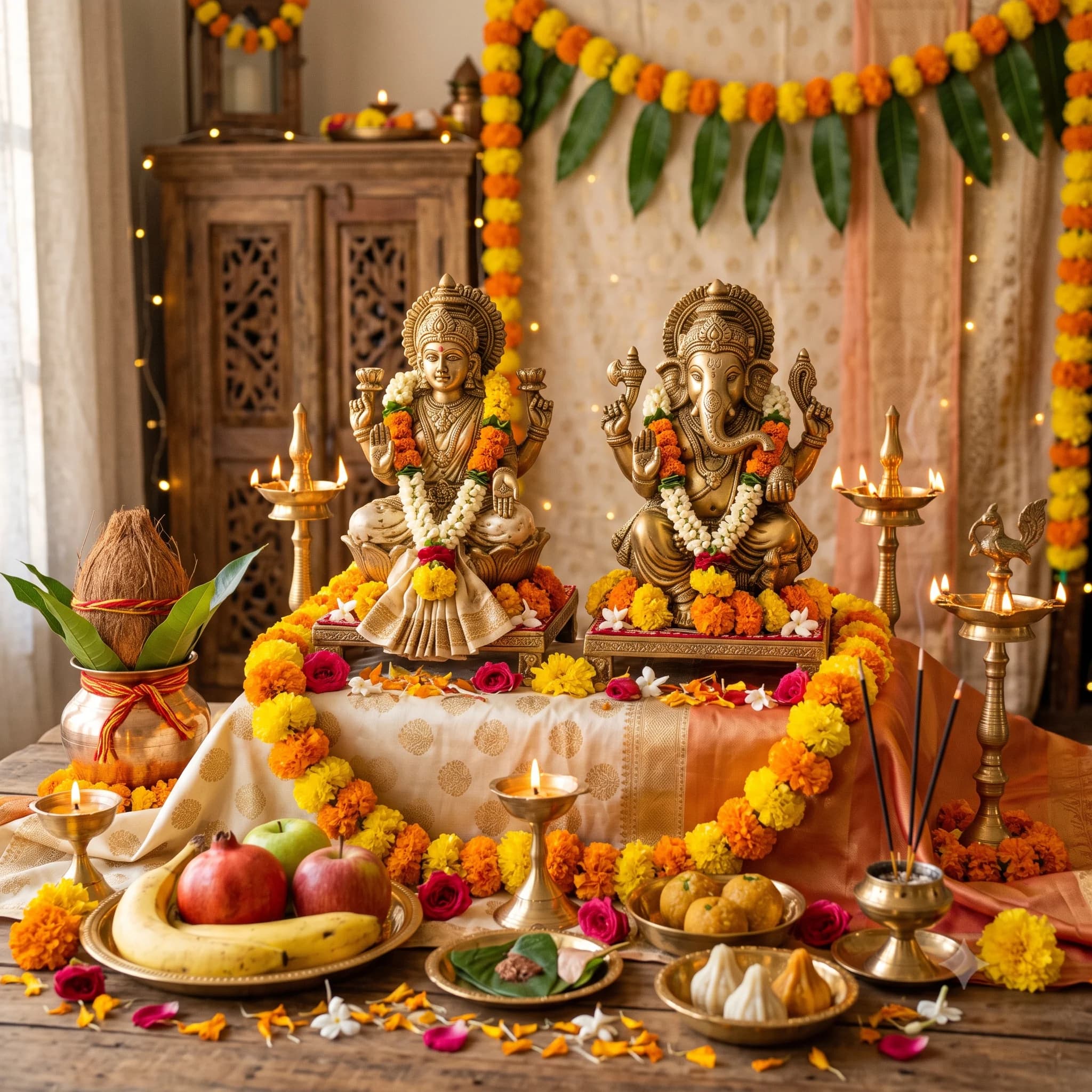
Lakshmi Puja on the evening of Diwali is the central worship of the festival. The family invites Goddess Lakshmi, along with Ganesha, into the clean, lit home, with prayers for prosperity, wellbeing and harmony. Below is a clear, practical vidhi for home. The background of the festival is in our guide to Diwali, its meaning and history.
Key takeaways
- The puja is done in the evening of Kartik Amavasya, within the Pradosh Kaal muhurat given for your city.
- Always worship Ganesha first, then Lakshmi. Kuber, Saraswati and the kalash are often included.
- A simple puja takes 45 to 60 minutes. Prepare the space and samagri earlier in the day.
- Businesses may also perform Chopda Pujan or Sharada Pujan for their account books.
When to do it
Lakshmi Puja is performed after sunset, usually in the Pradosh Kaal (the first few hours of the evening) while the Amavasya tithi is present, and some pandits also prefer the Sthira Lagna (a stable rising sign) within that window. Because sunset and tithi times vary by place, use a panchang for your city. See how to read a panchang. Families abroad can read Diwali puja abroad.
Samagri
- A chowki with a red or yellow cloth
- Images or idols of Lakshmi and Ganesha, optionally Kuber and Saraswati
- A kalash with water, a coconut, mango leaves and a few coins, supari and rice
- Roli, akshat (whole rice), turmeric, sandalwood, kumkum
- Flowers, a garland and a lotus if available
- Diyas, ghee or oil, cotton wicks and matches
- Incense, camphor, a bell, a thali and a conch
- Coins, a silver or gold item, rice, kheel (puffed rice), batasha, sweets and fruit
- Betel leaves and supari, and cloth for the deity
Our Lakshmi-Ganesh puja kit brings these together as a checklist.
Preparing the home
- Clean the home and keep the entrance tidy. Make a rangoli at the entrance.
- Decorate with lights, flowers and a toran.
- Choose a clean spot for the puja, ideally facing east or north.
- Arrange the chowki, spread the cloth and put some rice on it. Place the kalash on the right or at the centre.
- Place Ganesha to the right of Lakshmi, and the others as per your tradition.
Step by step
- Bathe and dress: wear clean or new clothes. Sit facing east or north.
- Light the lamp and incense: light a ghee lamp, and take a moment of silence.
- Sankalp: state your name, gotra, place and the intention to worship Lakshmi and Ganesha for the wellbeing and prosperity of the family. Take a little water and rice in your hand.
- Ganesh puja: invoke Ganesha, offer flowers, roli, akshat, durva and a sweet. Chant "Om Gam Ganapataye Namah".
- Kalash puja: offer roli, akshat and a flower to the kalash, which represents Varuna and the sacred waters.
- Lakshmi invocation: invoke Lakshmi, offer a seat of flowers, wash her feet symbolically with water, and offer a cloth.
- Lakshmi puja: offer roli, akshat, sandalwood, flowers and a garland. Offer coins and the new items bought on Dhanteras. Chant "Om Shreem Mahalakshmyai Namah" for a mala or at least 108 times, or recite the Lakshmi Sahasranama or the Shri Suktam if you know them.
- Kuber and Saraswati (optional): worship Kuber for wealth, and Saraswati for knowledge, with flowers and akshat.
- Offerings: offer the sweets, kheel, batasha and fruits as naivedya.
- Aarti: light camphor, ring the bell and sing the aarti "Om Jai Lakshmi Mata", then the Ganesh aarti. Circle the aarti plate before the deities and share the flame.
- Prayer and prasad: bow, ask for forgiveness for any shortfall, and distribute the prasad.
- Lamps: light diyas around the home, at the entrance and on the balcony. Keep a lamp burning near the deities as long as safely possible.
Chopda Pujan for businesses
Traders and business owners worship their new account books and tools in a Chopda or Sharada Pujan. A swastika is drawn on the book with roli, "Shubh Labh" is written, and the book is worshipped with Ganesha and Lakshmi. Many businesses begin their accounting year around this time.
Common questions about the rules
- Should the door be kept open? Many families keep the main door open and lit in the evening, to welcome Lakshmi. Do this safely.
- Which flowers? Lotus and red flowers are traditional. Marigold and rose are fine.
- Is it right to take a gift on Diwali? Giving sweets and gifts to family and neighbours is a custom.
- Can the puja be done by a woman alone? Yes. Anyone in the family can.
After the puja
Share a meal with the family, light the lamps, and visit relatives and neighbours. Next day is Govardhan Puja or the New Year in some regions, and then Bhai Dooj. If you would like a pandit to conduct the puja, see our Lakshmi-Ganesh pooja page, or speak with an Āchārya at a consultation.
Frequently asked questions
Can I do Lakshmi puja without a pandit?
Yes. Many families do. A pandit helps with the muhurat and the mantras.
What if I miss the muhurat?
Do the puja as close to the Pradosh time as you can, and ask your pandit about the nearest suitable window.
What should I do with the puja items afterwards?
Offer flowers to a river, plants or a tree. Keep the idol or image in your home mandir. Use the prasad with the family.
Planning your Lakshmi pooja?
Get the right muhurat and a pandit for your home or business.
